
Rishi Varahamihira was a renowned Indian astronomer, mathematician, and astrologer who lived in the 6th century CE. Varahamihira, one of the great Indian scientists that predicted water on Mars, iron on its sand, and among other accomplishments discovered comets. He was one of the nine jewels in the court of King Vikramaditya in Ujjain.
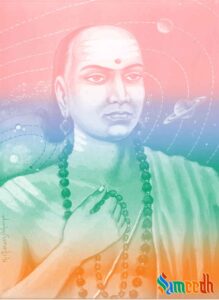
Rishi Varāhamihira was one of ancient India’s greatest astronomers, mathematicians, and astrologers — a true polymath whose works shaped Indian science for centuries.
Life & Background
-
Period: He lived during the 6th century CE, in the Gupta Empire’s later years (a golden age of science and arts in India).
-
Birthplace: Likely Ujjain (Madhya Pradesh), which was then a major center of astronomical studies.
-
Parentage: Son of Adityadasa, a learned Brahmin. His father taught him the basics of astronomy.
-
Title: Often called Mihira or Varāhamihira — “Varāha” being a family/clan name.
Major Contributions
1. Astronomy
-
Pancha-Siddhāntikā (“Five Astronomical Canons”)
A compilation comparing and harmonizing five earlier astronomical systems — Surya Siddhanta, Paulisa Siddhanta, Romaka Siddhanta, Vasishta Siddhanta, and Paitamaha Siddhanta. -
He calculated planetary positions, eclipses, solstices, and equinoxes with remarkable accuracy for his time.
-
Integrated Greek, Roman, and earlier Indian astronomical knowledge.
2. Astrology
-
Brihat Samhita
An encyclopedic text covering astrology, planetary omens, weather forecasting, architecture, gemology, perfumes, agriculture, and even cloud patterns. -
Brihat Jataka
A foundational text in Indian astrology, used for horoscopes and natal chart interpretation.
3. Mathematics & Other Sciences
-
Introduced improved sine tables and interpolation methods.
-
Discussed water divining (finding underground water), earthquakes, rainfall prediction, and even aspects of biology and botany.
-
Incorporated foreign knowledge, showing India’s openness to global ideas.
Speciality
-
Interdisciplinary genius: He combined astronomy, astrology, geography, architecture, botany, zoology, and even meteorology in his works.
-
Scientific mindset: Valued observation and empirical data, though often expressed in the symbolic language of astrology.
-
Cultural bridge: Integrated Indian traditions with Hellenistic and Persian sciences.
Legacy
-
Revered as one of the Navaratnas (Nine Gems) in King Yashodharman Vikramaditya’s court (often associated with Chandragupta II).
-
His works influenced Indian astronomy for centuries and even traveled to the Islamic world and beyond.
-
In modern Ujjain, an observatory (Vedh Shala) honors his memory.