
Rishi Bhaskaracharya (also known as Bhāskara II) was one of the greatest mathematicians and astronomers of ancient India. He lived during the 12th century CE (1114 – 1185 CE) and carried forward the legacy of Aryabhata, Brahmagupta, and Varāhamihira. He is often respectfully called “Bhaskaracharya” (Acharya = teacher) for his immense contributions.
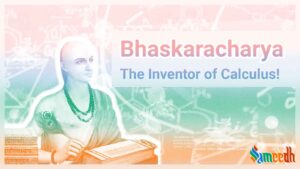
Bhaskara ii (1114 – 1185), also known as Bhaskara II and Bhaskara Achārya (“Bhaskara the teacher”), was an Indian mathematician and astronomer. The ii has been appended to his name to distinguish him from the 7th-century astronomer Bhaskara i.
Bhaskara was born to Mahesvara, a famous astrologer, near Bijjada Bida (present-day Bijapur district) in the state of Karnataka. Bhaskaracharya was the first mathematician to write a work with full and systematic use of the decimal number system. It is believed his father taught him mathematics, which he later passed on to his son Loksamudra.
Life
-
Born in 1114 CE in a village near Vijjadavida (present-day Bijapur in Karnataka, India).
-
He belonged to a scholarly Brahmin family with deep knowledge of mathematics and astronomy.
-
He headed the astronomical observatory at Ujjain, which was a major center for astronomical studies in ancient India.
-
His works were later translated into Persian and Arabic, influencing Islamic and European scholars.
Major Works
Bhaskaracharya wrote several texts, the most famous being Siddhānta Shiromani (Crown of Treatises), which has four parts:
-
Līlāvatī – on arithmetic, geometry, algebra (written in simple verses, often poetic).
-
Covers operations, fractions, equations, permutations, combinations, and geometry.
-
Contains charming problems told in a storytelling style.
-
-
Bījagaṇita – on algebra.
-
Solving quadratic, cubic, and indeterminate equations.
-
Concepts similar to modern algebra.
-
-
Graha-gaṇita (Planetary Mathematics) – on astronomy.
-
Calculation of planetary positions, eclipses, and conjunctions.
-
-
Golādhyāya (Spheres) – on spherical trigonometry and astronomy.
-
Discusses celestial spheres, planetary motions, and cosmology.
-
Contributions & Discoveries
-
Concept of Zero: Explained arithmetic operations with zero clearly.
-
Infinity: Early treatment of infinity and indeterminate forms.
-
Algebra: Solutions for quadratic and certain cubic equations.
-
Calculus precursor: Anticipated concepts of differential calculus and derivatives centuries before Newton and Leibniz.
-
Astronomy: Accurately calculated planetary motions, eclipses, and the Earth’s rotation.
-
Pi (π): Improved approximations of π.
-
Gravity: Mentioned the idea of objects being pulled towards Earth (similar to gravitational attraction).
Legacy
-
Called the “Last Great Mathematician of Classical India.”
-
His daughter, Lilavati, is said to have inspired the name of his arithmetic text.
-
His works influenced not just Indian but also Middle Eastern and European mathematics.
Bhaskaracharya combined deep mathematics with poetry, making his works timeless.