
Aryabhat was an Indian mathematician and astronomer, who lived during the reign of the Gupta empire. One of the world’s most acclaimed mathematicians, he is known as the ‘Father of Indian Mathematics’.
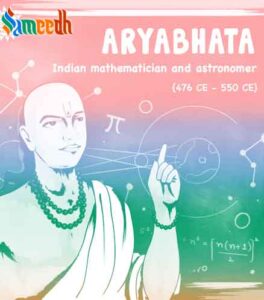
Rishi Aryabhat (476 CE – 550 CE) was a legendary Indian mathematician and astronomer, celebrated as one of the greatest scientific minds of ancient India. Born in Kusumapura (near modern-day Patna in Bihar), Aryabhat authored the famous treatise Āryabhaṭīya at the young age of 23. This remarkable work covers mathematics, astronomy, and calendrical calculations, and became a foundation stone for later scholars in India and beyond. In mathematics, Aryabhat introduced advanced concepts such as algebraic identities, quadratic equations, arithmetic progressions, and the place-value system using zero. He gave an approximate value of π (pi ≈ 3.1416) with astonishing accuracy and proposed that it was an irrational number. He also developed methods for calculating square roots, cube roots, and trigonometric functions (sine tables), making him a pioneer in trigonometry.
In astronomy, Aryabhata revolutionized traditional thought by proposing that the Earth rotates on its axis, which explains the apparent westward motion of the stars. He correctly explained solar and lunar eclipses as the shadows of the Earth and the Moon, rather than as supernatural events. His calculation of the length of the solar year (365 days, 6 hours, 12 minutes, 30 seconds) was remarkably close to modern values. Aryabhata also introduced the concept of a day measured in rotation of the Earth rather than the sun’s motion, a groundbreaking idea for his time.
Aryabhat’s influence spread far beyond India; his works were translated into Arabic in the 9th century, inspiring Islamic mathematicians and astronomers, and later impacting European science during the Renaissance. Revered as a pioneer of Indian mathematics and astronomy, Aryabhat is often honored as the father of Indian mathematics, whose insights continue to inspire modern science. In recognition of his legacy, India’s first satellite (launched in 1975) was named “Aryabhat” after him.