A day to remember victory of good over evil, victory of Ram over Ravan, victory of Durga over Mahisasur and victory of Arjun over Kuru army. But we shouldn’t limit it to mythology. There’s more to it.
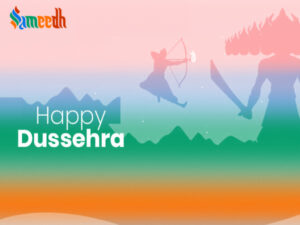
Dussehra, Dashera, Dusshera, Dashahara – so many ways that this very famous festival is spelled. Different meanings can be interpreted, depending on how it is spelled. Here are a few ways that I can think of –
Dashahara = Dash + Ahar. Dash means tenth and Ahar means day…tenth day (after celebrating Navratri for 9 days).
Dasha + Hara. Dasha means ten and Hara = defeat. Defeat of the one with ten heads (a.k.a. Ravan)
Dashera / Dusshera = Dus + Sher. Dus means ten and Sher = head. Remembering the one with ten heads (a.k.a. Ravan).
Any which way we look at it, it is a day to remember Ravan, the one with ten heads, his defeat by Lord Ram, on the tenth day. It is the victory of Goddess Durga over the demon Mahisasur. Coincidentally it is also the day, when Arjun single-handedly defeated the entire Kuru army on the last day of their fourteen year exile. That is why, it is also fondly remembered as Vijaydashmi. Vijay means victory and dashmi means tenth. Victory on the tenth day.
But as with any Hindu festival, this doesn’t just end with mythology. There is a lot to learn from it. Ravan had 10 heads.
Ravan was a learned man, an intellectual, an accomplished man. That is why, several places in India still conducts “Ravan Puja”, worshiping him. According one story, these ten heads equates to knowledge of four vedas and six shastras (Sankhya, Yog, Nyaya, Vaisheshik, Purvamimamsa, Uttar Mimamsa). It takes an acutely intelligent person years to learn and master each of these texts. Ravan knew every one of them! So how does a person with that level of intellect lose? Emotions. Emotions that replaced these virtues with vices.
Just like Ravan, we all have 10 heads. It’s what we carry with us in our heads. These are 10 vices that brings us down –
- Kam (Lust)
- Ahankar (Ego)
- Jadta (Insensitivity)
- Krodh (Anger)
- Moh (Attachment to worldly objects)
- Lobh (Greed for material objects)
- Mad (Pride and arrogance)
- Matsar (Jealousy)
- Paschatap (Regret)
- Bhay (Fear)
Some other interpretations remind us (just like chapter 13 of Bhagvad Gita) that we’re made of ten qualities. They are:
- Kam (lust)
- Krodh (Anger)
- Lobh (Greed for material objects
- Moh (attachment to worldly object)
- Mad (Pride and arrogance)
- Matsar (Jealosy)
- Man (mind)
- Chitt (consciousness)
- Buddhi (intellect)
- Ahankar (ego / self-awareness)
We must use our intellect and knowledge about self defeat the vices. Otherwise, you need to have what it takes to invite Lord Ram to get rid of them for you.
As the famous song from Swades reminds us “man se Ravan jo nikale, Ram uske man mein hai”. Just like that, Ravan and Ram are state of mind. They symbolize who we are. What we’re capable of doing, how wer’re capable of running.
There are many customs, foods and celebrations associated with Dusshera. Worshiping your vehicles that carry and protect you to eating special dishes (Fafda and Jalebi being the most famous), Dushera is a precursor to the festive season of Diwali.
So let us celebrate this day with letting our virtues defeat our vices, let our goodness burn the effigies of bad and let us raise the level of intellect to know thyself.