The Mundak Upanishad explains the hierarchy of knowledge and correct ways to achieve the ultimate knowledge of Brahman. It has been cited by numerous scholars throughout the world.
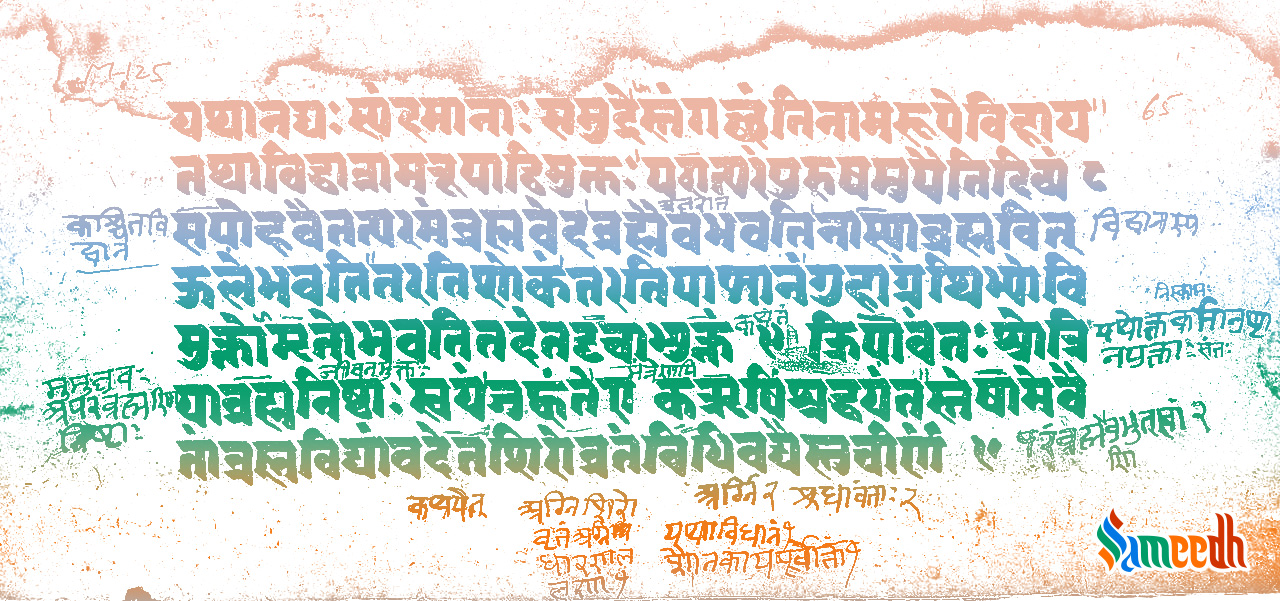
Mundaka Upanishad manuscript page, verses 3.2.8 to 3.2.10, Atharvaveda (Sanskrit, Devanagari script) ; Image Source: Sarah Welch
What is Upanishad?
Upanishad is the scriptures that connect the knowledge given in the four Ved to common people’s lives and traditions. They are called Upanishad (sitting down closely) because Upa means ‘near’ and Shad means ‘to sit’. Many of the Upanishads are written in the style of a conversation between a Guru and a Shishya sitting near the feet of the teacher. Upanishad are aimed at bringing prosperity, enlightenment, and most to the common people’s lives. Every Upanishad is focused on the knowledge covered in one particular Veda from Rigveda, Samaveda, Shukla Yajurveda, Krishna Yajurveda, and Atharvaveda.
The Legacy of Mundak Upanishad
The knowledge of Mundak Upanishad used to be given to students in various gurukul in India, but they were not available in the book form. Later on, many scholars from different parts of India created formal scriptures in several different languages. That’s why we can’t trace one origin of these Upanishad.
However, Mundak Upanishad remains one of the most popular Upanishad, with many noted scholars citing it in their works. Scholars such as Anandgiri, Badarayana, Shankaracharya in ancient times and many contemporary western scholars have also cited Mundak Upanishad in their works.
The teachings of Mundak Upanishad
Mundak Upanishad is one of the most important and primary Upanishad related to the Atharvaved. It has 64 verses which explain the glory of knowledge and its hierarchy. It says that the knowledge in its purest form was given by the creator Brahma to his son Atharva, and he gave it to the scholar rishis – as guardians of knowledge. It is written that acts of rituals and offerings are not fruitful; only the ultimate knowledge of Brahman – can be of significance.
It is subdivided into three mundakam. In the first mundakam, the knowledge is classified into two broad categories – Lower Knowledge and Higher Knowledge. In the second mundakam, the truth of AUM, oneself, brahman and paths to reach it – are explained. And in the third mundakam, the methods of travelling on those paths and reaching true knowledge about brahman – are denoted.
Lower Knowledge Vs. Higher Knowledge
The Mundak Upanishad states that there are two kinds of knowledge, and both are necessary to achieve the ultimate knowledge about brahman. The lower knowledge is useful for the common people who seek to connect with the divinity through prayers, worship, offerings, rituals, pilgrimage, penance, etc. This knowledge stems from the four Ved.
The higher knowledge is not ‘a knowledge about divinity or science’; the higher knowledge is the ‘truth of oneself’. It is not about acquiring some information, but it is about experiencing oneself without any distortion or mediation by an external entity.
The biggest difference it explains – is between ‘Dharma’ and ‘Jnana’. It says that ‘Dharma’ leads a person on the path of different types of karma, which may or may not inspire him to seek the ultimate ‘Jnana’. However, the one on the path of ‘Jnana’ ultimately becomes self-sufficient, and it doesn’t have desires, attachments, or doubts.
The motto of Independent India
The phrase ‘Satyamev Jayate’ is taken from the Shlok 3.1.6 of Mundak Upanishad. It means that ‘Only Truth Triumphs, Not Lies’.