We all pray to Sun as God; however, we vaguely understand his significance. Let us try and understand his origins and why he is special to us.
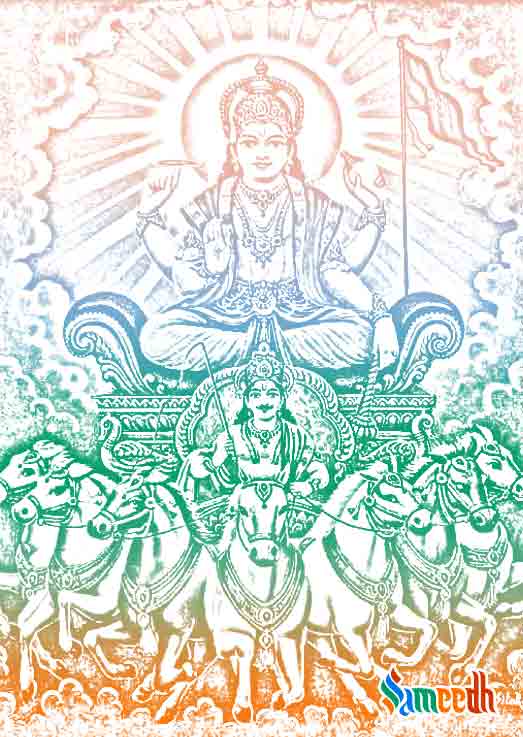
Surya (Aditya) is a deity in Hinduism. He is traditionally one of the major five deities in the Smarta tradition, all of whom are considered as equivalent deities in the ‘Panchayatana puja’, a means to realise the Brahman. He is considered the creator of the universe and the source of all life. He is the supreme soul who brings light and warmth to the world.
Hinduism is a major world religion originating on the Indian subcontinent and comprising several and varied systems of philosophy, belief, and rituals. It refers to a rich cumulative tradition of texts and practices, some of which date to the 2nd millennium BCE or possibly earlier
Surya first appears in literature in the Rigveda, oldest of the Vedas composed between 1500 and 1000 BCE. The oldest surviving Vedic hymns, such as the hymn 1.115 of the Rigveda, mention Sūrya, with particular reverence for the ‘rising sun’ as dispeller of darkness, one who empowers knowledge, the good and life. The Gayatri Mantra is associated with Sūrya. The mantra’s earliest appearance is in the hymn 3.62.10 of the Rigveda.
Surya is considered to be the son of sage Kasyapa and Aditi. Surya had three offspring with Sangya, the daughter of Visvakarma. These were Vaivasvata (Manu), Yam, and Yami. Later, Sangya became tired of Surya’s brilliance that she left him, transformed into a mare to live a life of reflection (Chhaya) in the forests. However, Surya disguised as a stallion mated and the resulting offspring were Revanta and twin sons, the youthful 2 Ashvins.
Surya is also considered the chief of the nine planets of Vedic antiquity. These are the Sun, Moon, Mercury, Mars, Venus, Jupiter, and Saturn, Rahu and Ketu, all visible to the naked eye. Collectively they are referred as the Navagraha.
Surya is one of the several trinities along with Agni, Vayu or Indra, presented as an equivalent icon and aspect of the Hindu metaphysical concept called the Brahman. In the Brahmanas of Vedic literature, Surya appears with Agni in the same hymns. Surya is revered for the day, while Agni for its role during the night.
In Ramayana, Lord Rama was taught the Ādityahṛdayam stotra before his war against Ravana. The Mahabharata opens its chapter on Surya that reverentially calls him as the ‘eye of the universe, soul of all existence, origin of all life, goal of the Samkhyas and Yogis, and symbolism for freedom and spiritual emancipation.
The Brihat Samhita of Varaha Mihira states that Surya should be shown with two hands and wearing a crown however, the Vishnudharmottara states that Surya should be shown with four hands, with flowers in two hands, a staff in third, and in fourth he should be shown to be holding writing equipment. His chariot driver in both books is stated to be Aruṇa who is seated. Two females typically flank him, who represent the dawn goddesses named Usha and Pratyusha. The goddesses are shown to be shooting arrows, a symbolism for their initiative to challenge darkness. In other representations, these goddesses are Surya’s two wives, Samjna and Chhaya.
12 Popular Names of Suryadev in Hindu texts are as follows:
- Mitraya – The friend of all
- Ravaya – Praised by All
- Suryaya – The Guide of all
- Bhanave – The Bestower of Beauty
- Khagaya – Simulator of Senses
- Pushne – The Nourisher of All
- Hiranyagarbhaya – The Creator
- Marichaya – The destroyer of diseases
- Adityaya – The Inspirer
- Savitre – The purifier
- Arkaya – The Radiant
- Bhaskaraya – The Illuminator