
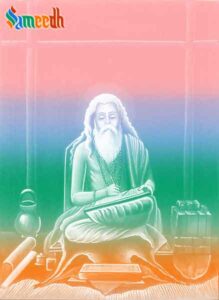
Rishi Lagadh, also known as Lagadhacharya, was a revered Vedic sage and one of the earliest known astronomers of ancient India. He is traditionally credited with composing the Vedānga Jyotisha, the oldest surviving Indian text on astronomy and astrology, dated around 1200–1000 BCE.
Life and Background
-
Rishi Lagadh was an ancient Vedic sage remembered as the earliest known Indian astronomer and astrologer.
-
He lived during the late Vedic period (around 1200–1000 BCE).
-
Though exact details of his birthplace and personal life are unknown, he is traditionally credited as the author of Vedānga Jyotisha, the oldest Indian text on astronomy.
-
He was associated with the Rigved and Yajurved traditions, as his work survives in two recensions linked to these Vedas.
Teachings and Philosophy
-
Rishi Lagadh believed that time (Kāla) was the foundation of order in the universe and essential for performing Vedic rituals correctly.
-
His philosophy emphasized:
-
Alignment of human activities with cosmic order.
-
The idea that rituals are effective only when performed at precise times, determined by the movements of celestial bodies.
-
Observation of the sun, moon, and stars as guiding forces for dharma and spiritual life.
-
Works and Contributions
Vedānga Jyotisha
-
His most important work, considered the earliest surviving text on Indian astronomy.
-
Purpose: To provide a calendar and timekeeping system for accurate performance of Vedic yajnas (sacrifices).
Key Features:
-
Five-Year Yuga System – to synchronize the solar year (365 days) and lunar year (354 days).
-
Nakshatra-based Astronomy – mapping the sky into 27 constellations (Nakshatras), a concept still central in Hindu astrology.
-
Rules for Tithis – calculation of lunar days, essential for rituals.
-
Solstices & Equinoxes – recognition of the movement of the sun and its seasonal impact.
-
Calendrical Framework – early foundation of the Hindu Panchang (almanac).
Legacy and Influence
-
Rishi Lagadh is often hailed as the father of Indian astronomy.
-
His work influenced later great astronomers:
-
Aryabhata (5th century CE)
-
Varāhamihira (6th century CE)
-
Bhaskara I & II (7th and 12th century CE)
-
-
Even today, Hindu religious and cultural life—festivals, rituals, auspicious timings (muhurtas)—are based on principles first codified in his system.
-
His emphasis on cosmic order and ritual harmony highlights the deep connection between science and spirituality in Vedic culture.